
What I Learned From My First Marathon

Last week, I ran my first ever marathon. This wasn’t something that I had originally planned to do. My wife had her place booked as soon as entries opened, and I made the decision to join her less than two weeks before the race. The result? No specific training, just my base level of fitness to get me through over 26 miles. Want to know some lessons that I took away from it? Read on…

Housekeeping
Here are a few quick reminders before we begin:
You can access my entire free archive of educational Muscle Monday and Workout Wednesday newsletters here.
You can download my guides, 20 Habits to Change Your Life, here, and 28 Health and Fitness Targets, here.
You can get 10% off EVERY order at Awesome Supplements by using the code ‘EZEP’ at checkout.
Paid subscribers get full access to exclusive newsletters. Upgrade your subscription below if this interests you.
“Anyone Can Do It…”
Rightly or wrongly, before last week, I was under this impression. If there was a gun to my head (or to yours for that matter), most of us would find the energy and determination to complete a marathon in some form, whether we ran, walked, crawled or sobbed across the finish line. I was just happy to finish! In a time of 4:18:26 for those interested (my wife romped home in 3:28:02 - smashed it!). However, that nearly 4.5-hour period was a steep learning curve for me. Let’s have a look at the lessons I have since learned…
Time on Feet Trumps Everything
In any other race in which I have competed, my legs have been OK, but I’ve been blowing big time. I think back to many 5k, 10k and the one half marathon race I completed before this week, in which I physically couldn’t get enough air into my lungs to pick up the pace. Due to my lack of marathon training, this was completely reversed in Amsterdam.
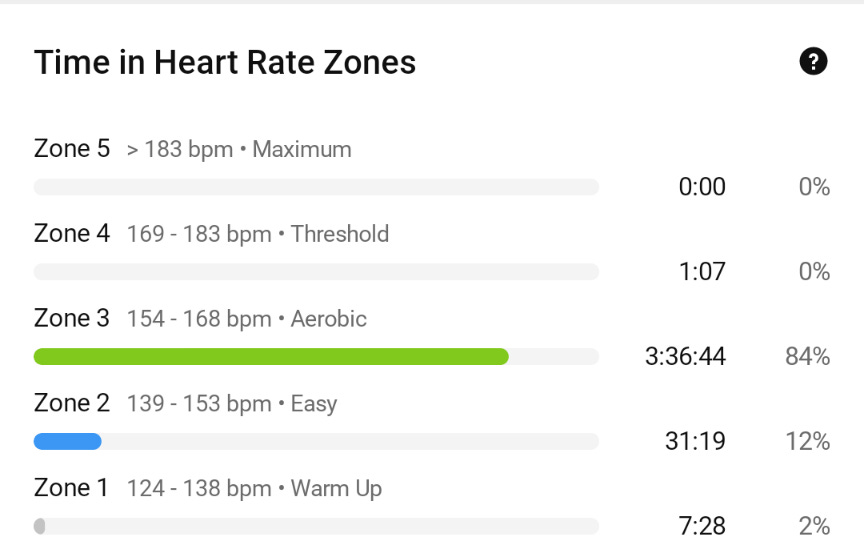
Take a look below at my heart rate zone data. I only spent just over a minute above Z3 intensity in the entire race. Marathon pace is commonly well matched to being just below lactate threshold pace, which often comes at around the Z3/Z4 border. By luck, I managed to hold an intensity which didn’t rise too high, too soon. Therefore, I didn’t feel, and clearly, I wasn’t put under any overwhelming central fatigue stemming from the cardiovascular system. In this instance, my limiting factor was a peripheral issue, a muscular issue, not a central limitation.
It sounds silly, but I just hadn’t accumulated the tissue tolerance to go faster. In fact, just two weeks ago, my longest ever run was 2 hours. This time last week, it was 2.5 hours. As of today, it is 4:18 from the marathon. This means that I added nearly 2 hours onto my longest ever run (I nearly doubled it!) Logically, my calves, quads and hammies were always going to struggle the most, but I underestimated just how much it would hurt.
However, perhaps even more damaging was the mental burden. I knew that I would be aware of the 2.5 hour mark as I crossed it during the race, but I didn’t realise how hard it would be after this point…
“The Wall” Does Exist, But Not In The Way I Expected
As 2.5 hours approached, I knew I would enter unfamiliar territory. At this point, I was well over halfway through. In fact, my pace for the first half was almost perfectly measured at 4 4-hour marathon pace. I felt that this wasn’t outrageous, as I’d run a sub-2-hour half-marathon in my 2.5-hour easy long run the week before. I have also run 1:40 for a half a few years ago, although, admittedly, I was in much better shape for that!
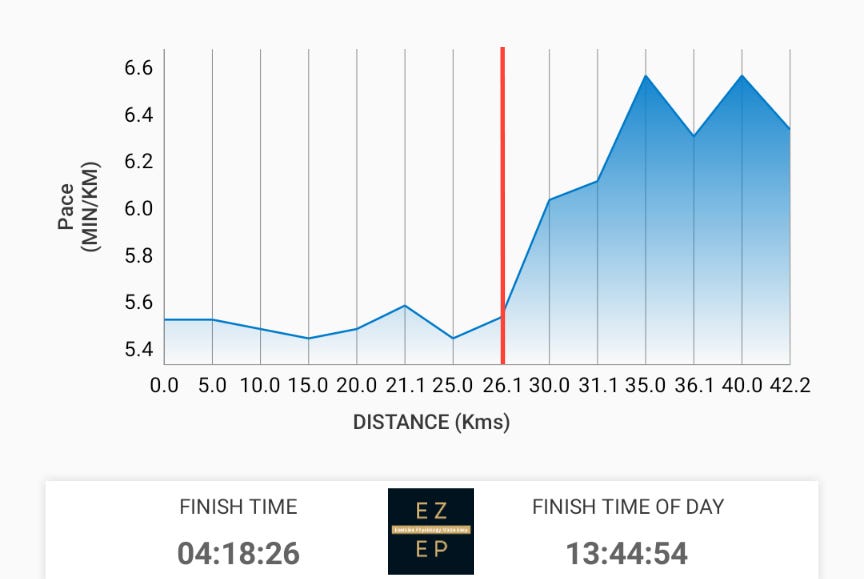
I’ve inserted my pace graph below. In there, you’ll see a red line which lies at 2 hours and 30 minutes, which reflects my previous longest ever run. To the left of this red line, everything is great. I’m bang on 4-hour pace and in familiar territory. However, as you can easily see, things take a turn for the worse to the right of this line. My pace plummets over the next 10k, before I manage to stop the rot for the home stretch.
More than anything, I think that this shows the power of both mental and physical fatigue. By the red line below, my legs ached, and my mind was telling me to slow down. My brain and my body both knew that this was further than I had gone before, and my pace reflects this. In my experience, “The Wall” wasn’t this invisible barrier which brought me to a halt. Instead, it was more like superglue on my shoes, which slowed me down gradually, making every step harder and playing my own mind against me.
Pacing is More Important Than I Realised
In many of my previous runs, races and events, I’ve always been sure to start off slowly and build into a race. In fact, I would go as far as to say that I almost always run negative splits, which is a term that describes the second half of a run being faster than the first half. However, as we’ve established, the marathon was different.
I set off knowing that 5:42 mins per km would equate to roughly 4 hours for a marathon, and that even 6:00 mins per km would keep me under 4:15. The ticket I bought in the days before the event had previously belonged to a chap (who was pulling out of the event, and selling his official spot) in the starting wave of runners aiming for 3:30-4:00 hours to complete the run. In hindsight, starting in this wave was a mistake. I was swept along with these guys and gals, running well under 5:42 mins per km for a chunk of the inital race period. I tried to kid myself that this wouldn’t backfire towards the end of the race, but it definitely did! By the time the final quarter of the race came round, I was running at well over 6 minute per km pace. In fact, my Garmin logged my actual marathon average km pace at 6:01 minutes. Of course, this isn’t my official chip time, and if you believe the accuracy of the GPS data, I actually ran 400m more than a marathon, probably through weaving in and out and not taking the racing line. Would starting off at a slower pace have saved me later on? I doubt it. I would probably just have declined more steadily.
Support Makes A Big Difference
Some people are extremely motivated by crowds and support, whilst others don’t really notice a difference. However, I have to say that the crowds did help me get back moving at a decent pace in the final 10k (or at least it felt this way). If nothing else, you feel guilty for slowing to a walk or slow jog when people are calling your name! It also helps knowing that you may go past a familiar face, and trying to spot them in the crowd is a great way to keep yourself distracted from the pain in your legs.
I’m Not As Prone to Running ‘Accidents’ as I Initially Feared
You always hear horror stories of athletes getting caught short due to a lack of facilities, race day nerves, or just the sheer volume of gels, caffeine and sloshing about going on for hours. I had to face this fear directly when, at the first water station, I accidentally drank a vague ‘energy’ concoction rather than a cup of water. So much for not trying anything new on race day! I was absolutely convinced that I’d be squatting in a field somewhere after that mistake, but thankfully, this was never needed. Maybe I’m just not enough of a runner to suffer from this common issue. In fact, by the latter water stations, I was taking on water, banana slices, and energy drinks with no ill effects…although this was probably just blind luck!
There’s Always More Left in the Tank
The Amsterdam marathon was a lovely event for many reasons, but one major plus was that the final few hundred metres took you back into the Olympic stadium for the finish. No matter how hard you’re working, how slow the pace has dropped, and how sore the knees are, there’s something about the end being in sight that taps into some long-forgotten energy reserves.
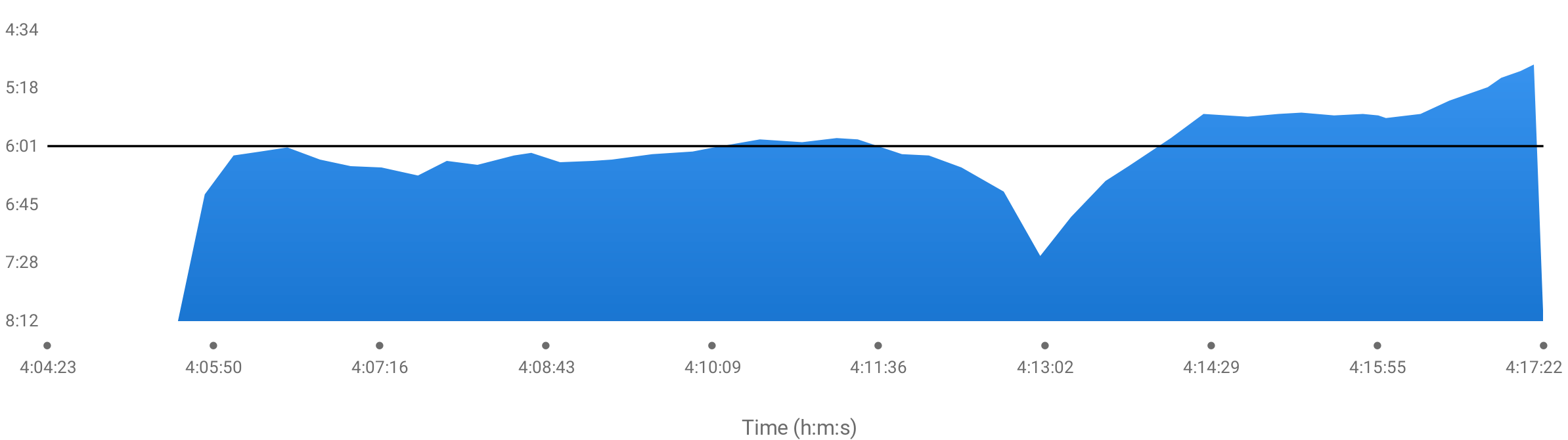
Take a look at the image below. You can see the moment my heart drops as I see the 41km marker, signalling that I’ve still got over 1km to go. However, straight after this, you can see the penny dropping as I realise that this isn’t very far at all, with the stadium coming into view.
Even more amazing - you can see the final increase in pace as I enter the stadium, knowing there’s less than 300m to go, with some softer ground underfoot. I eventually got back to 5:10 mins per km pace on the track, after spending nearly 90 minutes at over 6 mins per km. Like I said, there’s always something left in the tank.
Key Takeaways
If you’ve not trained sufficiently, the legs will be the limiting factor.
It is a mental battle as much as a physical one.
No matter how tired you are, you’ll find a way to pick up the pace when you can see the finish.
Don’t try any new gels or drinks on the day of the event itself; I was lucky that it didn’t backfire!
Thanks for reading, folks. Back to regular newsletters from next week, starting with “When to Ignore Your Smartwatch”.
Congrats Ben!
I think it’s impressive given you’d only run half that amount of time in training !
Congrats man! That’s a great time, especially given your first try and you registered on a whim. Think you’ll do another one now?