
At-Home Testing Part Two: Improving All Aspects of Your Fitness
You've done the tests, now let's improve those weaker areas.

Last week, I wrote about 7 fitness tests which could be performed in the comfort of your own home. Since then, I’ve been dealing with a whole load of messages from readers asking how they can improve their scores. Luckily, I planned to always include those answers in part two of this mini-series. Whether your posture needs work or your cardiorespiratory fitness is lower than it should be, everyone will have one key area which could do with some improvement. Today, I’ll outline some easy implementations to fix these issues. So, if you’ve not yet had a chance to read last week’s newsletter, just hit the links below to learn how to perform the tests and record your scores, then you can use today’s newsletter to improve those scores.


Before We Start
A couple of things…
Thank you to those who completed the poll in last week’s newsletter. For those who didn’t catch it, I asked which of the 7 tests you scored lowest on. I’m very surprised to see that the shoulder scratch test was by far the worst-scoring assessment, with 70% of the vote. The sit and rise test, which I had expected to be the hardest test by a mile, came in second with 23% of the vote (at the time of writing). If you wish to contribute to this poll, it remains open, so just click or tap here.
Secondly, I wanted to reassure you that there’s no need to stress if you scored lower than you’d like on some or all of the tests. The scores can all be improved. For today, pick 2 or 3 tests that you scored lowest on and implement the suggested changes for those, rather than trying to improve everything at once.
Finally, some of you may think that to improve at the tests, you just need to keep practising the tests. While this will improve your scores, it won’t improve the underlying shortcomings which caused your initial low scores, and it won’t always be practical. For example, let’s take the sit-to-stand test. That is an index of back, hip, glute, hamstring and quadriceps function. By practising the test, you’ll get better at the test, but in a very specific manner, which isn’t helpful in real life. It is better to improve all of those components in a comprehensive manner and with varied stimuli.
Test #1 - Single Leg Balance (Eyes Shut)
Ideal Target
At least 10 seconds on each leg.
How to Improve Your Balance & Proprioception
Balance, like strength, power and cardiorespiratory fitness, is a component of fitness which tends to suffer with age. However, this shift tends to happen slightly later, after ~45-50 years old. Of course, it also depends on whether you’ve had any ankle or foot injury throughout your life, too.
If you struggled with this test, then break it down to the basics.
The first step is simple. Every day, balance on one leg with your eyes open for at least a minute per leg. The classic example here is to balance on one leg as you brush your teeth, swapping legs halfway through. Try this for two weeks.
After two weeks, incorporate the ‘eyes shut’ element of the challenge every day. Your time will probably plummet, but that is expected. The body will improve quickly, though, since balance and proprioception are heavily influenced by the nervous system, and don’t require large increases in strength, fitness or muscle mass, which takes time.
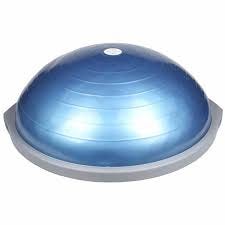
After this second phase, you can add progressions. If you have access to a BOSU ball, then try balancing on this. If not, then try to balance while standing on a cushion. If that is still too easy, then add some form of cognitive challenge as you balance. This could be to recite the alphabet backwards, count down from 100 in intervals of 7, or try to recite multiples of 13. By the end of this mini-training block, you should find that your balance has markedly improved through just 2 minutes of balancing per day.
Test #2 - The Cross-Legged Sit & Rise
Ideal Score
At least 8 out of 10.
How to Improve ‘Real Life’ Mobility & Strength
This test is useful for many reasons, but I love it because it incorporates movements that you will perform for the rest of your life. We should all be able to sit cross-legged comfortably for extended periods and stand up without clinging to supports. It is possible to be simultaneously ‘gym strong’ and ‘real world weak’, and this test highlights whether this might be a problem you suffer with. Also, remember that if you’re a desk worker or spend a lot of time seated during the day, improving on this test will be more beneficial to you than for those who are already very active.
The best method for improving at this test is to improve your lower back, hip and hamstring function. Therefore, performing these stretches and exercises below every day for 4 weeks should give you just the stimulus you need to improve.
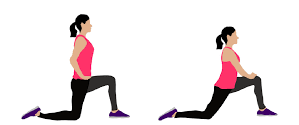
Kneeling hip flexor stretch (3x 30s per leg)
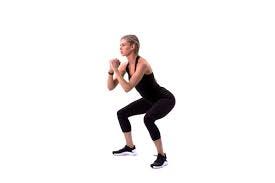
Squat holds (3x 30s)
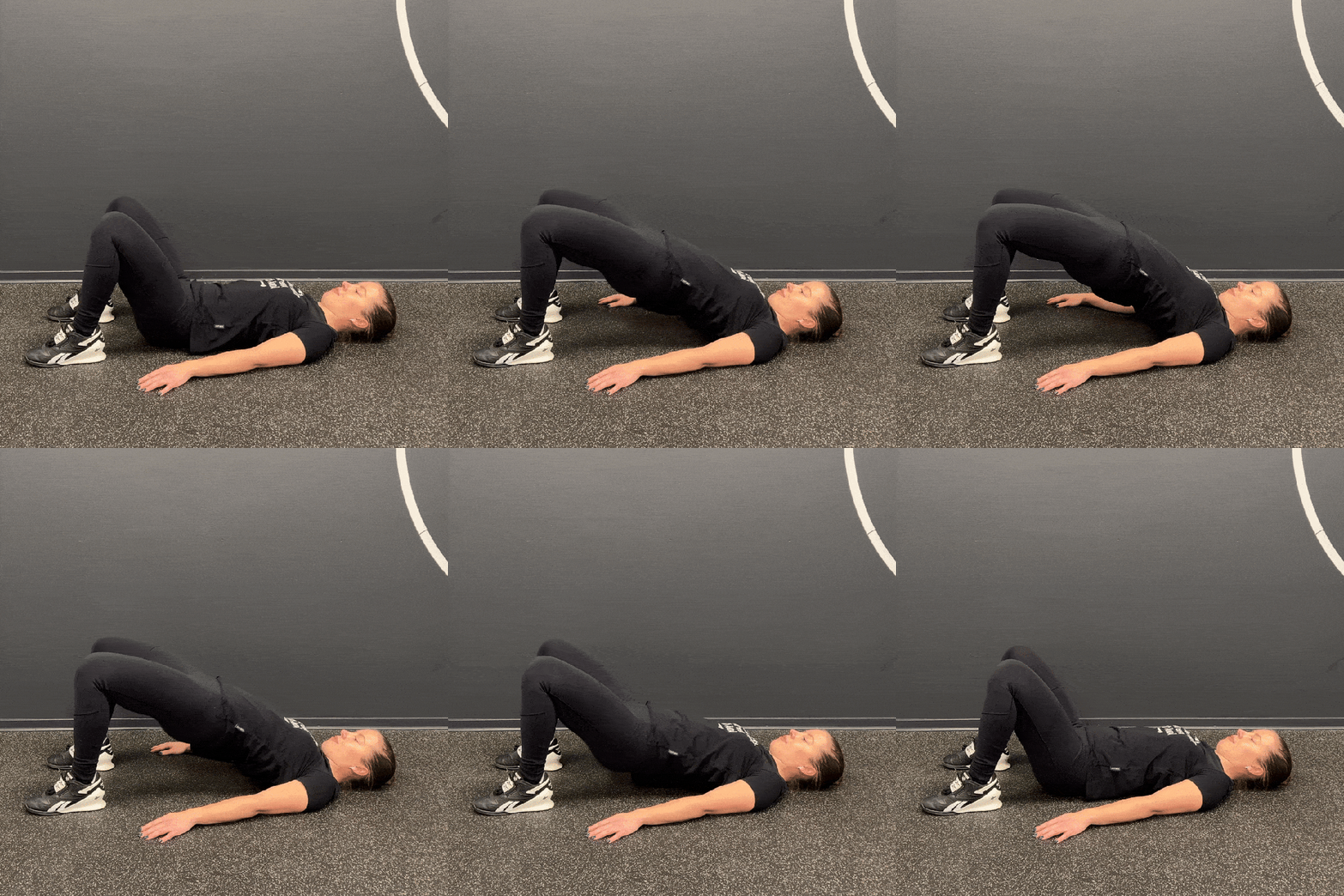
Glute bridges (3x 15 reps, holding for 3s at the top)
Test #3 - Wall Posture Test
Ideal Score
Able to keep the head, upper back and shoulders in contact with the wall.
How to Improve Your Posture
This is another implementation which will benefit desk workers or sedentary people more than active ones. Poor posture is almost always due to working conditions. Because of this, it is important to be realistic with your expectations of how quickly your posture will improve. If it has taken years of desk work or driving to deteriorate your posture, it will take more than a month to reverse these changes. However, strength in those weakened muscles will increase very quickly. It just might take a bit longer to see noticeable changes.
I would recommend the following exercises daily for 6 weeks. It feels like a long time, but considering how much it can improve your neck and shoulder health, it is a worthwhile habit for just 10 minutes per day.
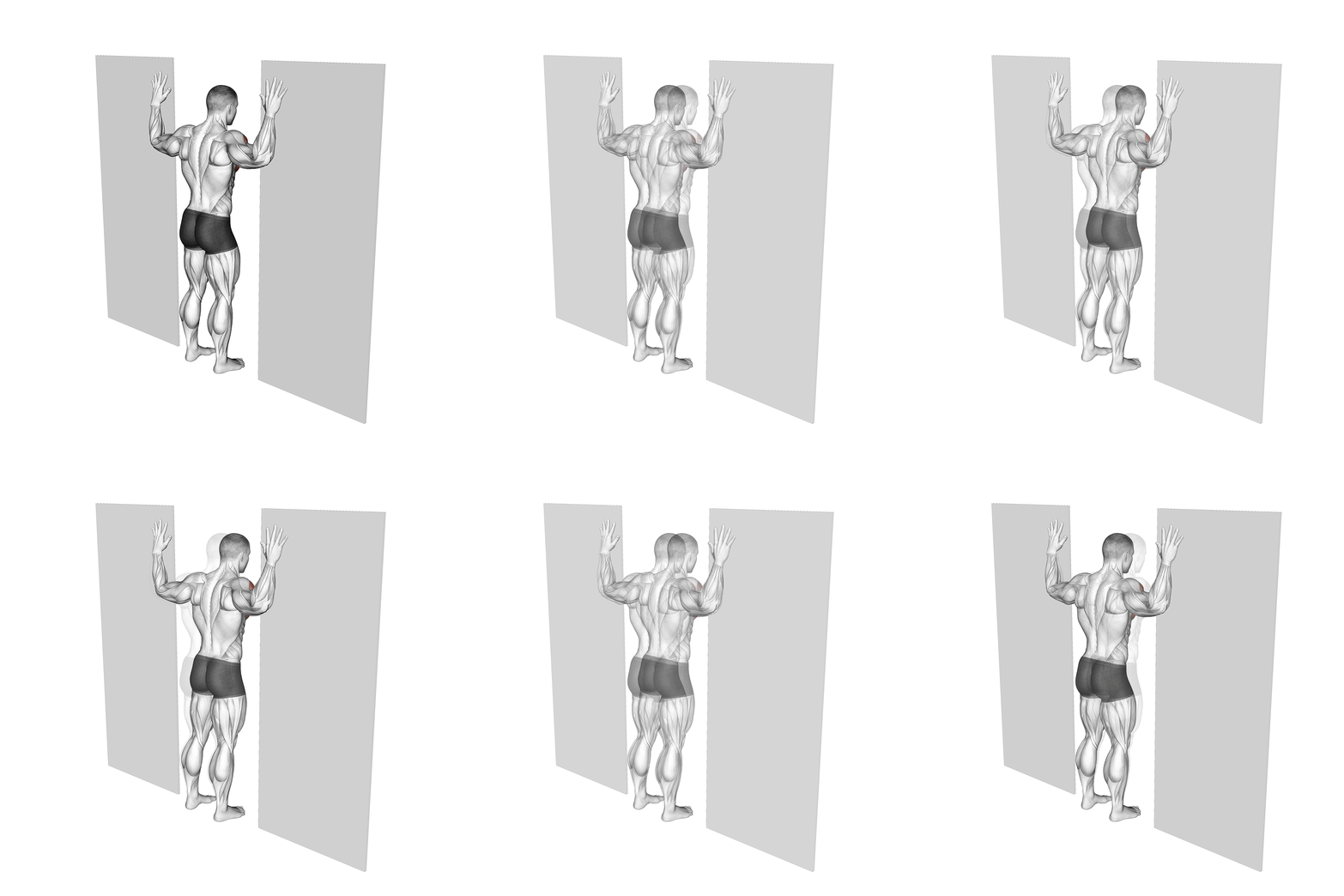
Doorway stretch (2x 60s)
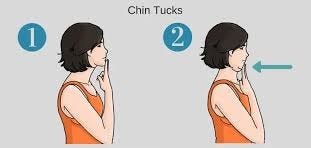
Chin tucks (3x 10)
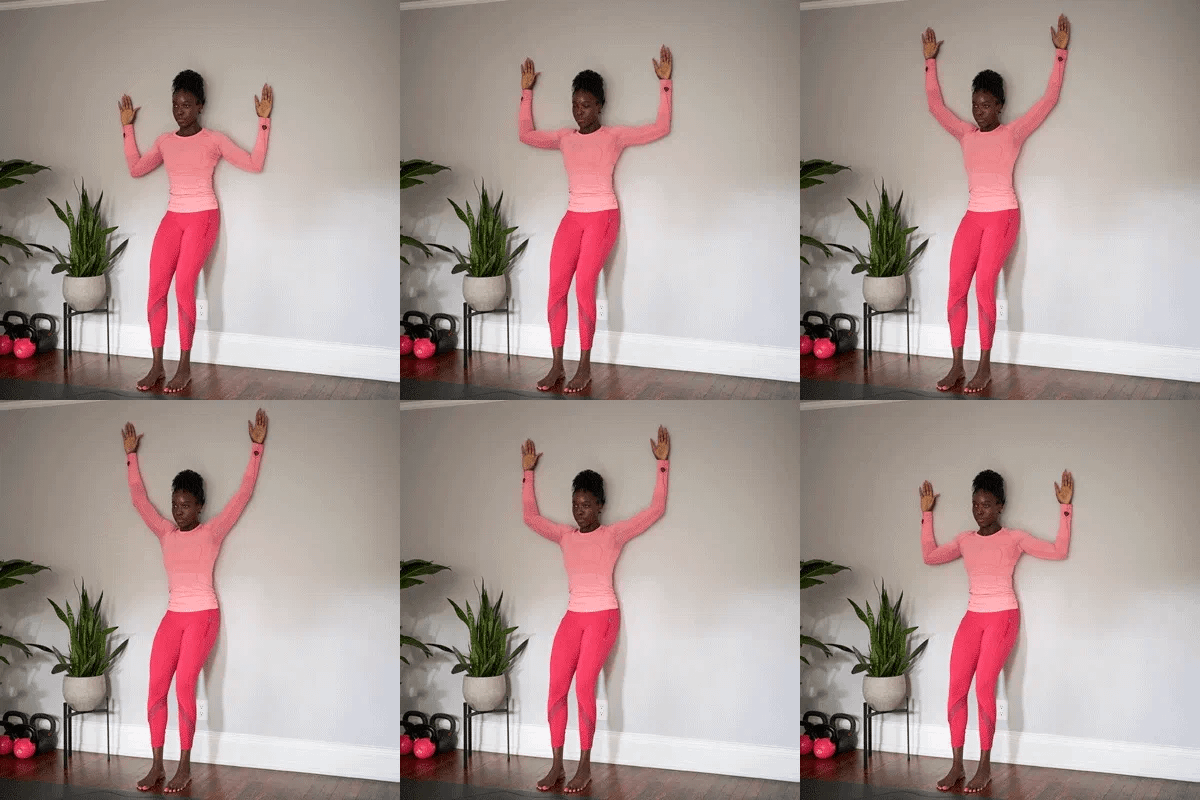
Wall angels (2x 60s)
Test #4 - YMCA Step Test
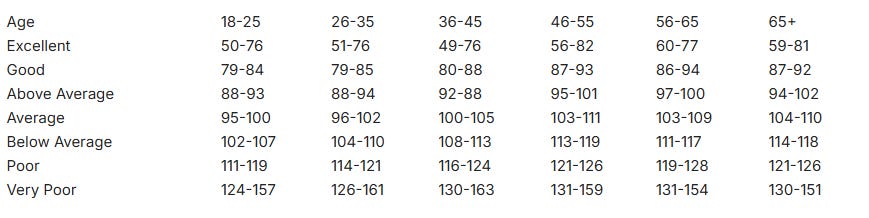
Ideal Score
How to Improve Your Cardiorespiratory Fitness
Some great news here: there are hundreds of ways to improve your cardiorespiratory fitness. The challenge is how to find the method which best suits you. If you specifically wish to improve your VO2max, I have written extensively on this topic previously, and you can read my outline on this by tapping or clicking here. For this newsletter, and because I’m fed up with buzzwords like ‘Zone 2’, I’ll outline a simple series of steps for improving general cardio fitness.
Get walking more. If you can’t walk, find a suitable alternative like cycling or rowing in the gym. Build a base of low-intensity movement for the next 6 weeks. Stay consistent, and aim for at least 20 dedicated minutes of this movement each day.
On one day per week, take it up a notch. Find a hill and walk up it at a decent pace. Do this for 3-5 minutes, then walk slowly back down. Repeat this 2-4 times. If you’re cycling, rowing, or using another form of exercise, you can adjust the gears/damper settings.
After 6 weeks of this plan, re-test the YMCA, and you should notice an improvement. Stick with this for 12 weeks, and you’ll notice a significant improvement.
Test #5 - The Shoulder Scratch Test
Ideal Score
To be able to reach your fingers together on both sides of the test.
How to Improve Shoulder Mobility
You guessed it: shoulder mobility tends to be particularly poor in older adults or in desk-based or sedentary jobs. However, some simple stretches and strength work can help to undo the stiffness that plagues so many people. It is also worth remembering that asymmetry is an issue to keep an eye on here. Most of us are less stiff on one side of the body compared to the other. It is important to try to be as even as possible to reduce the risk of injury to the muscles further down in the chain. With that in mind, here are three exercises that I would recommend daily for the next 4-6 weeks.
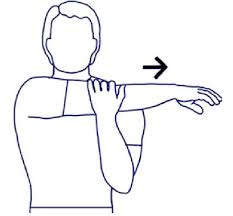
Cross body stretch (2x 30s per side)
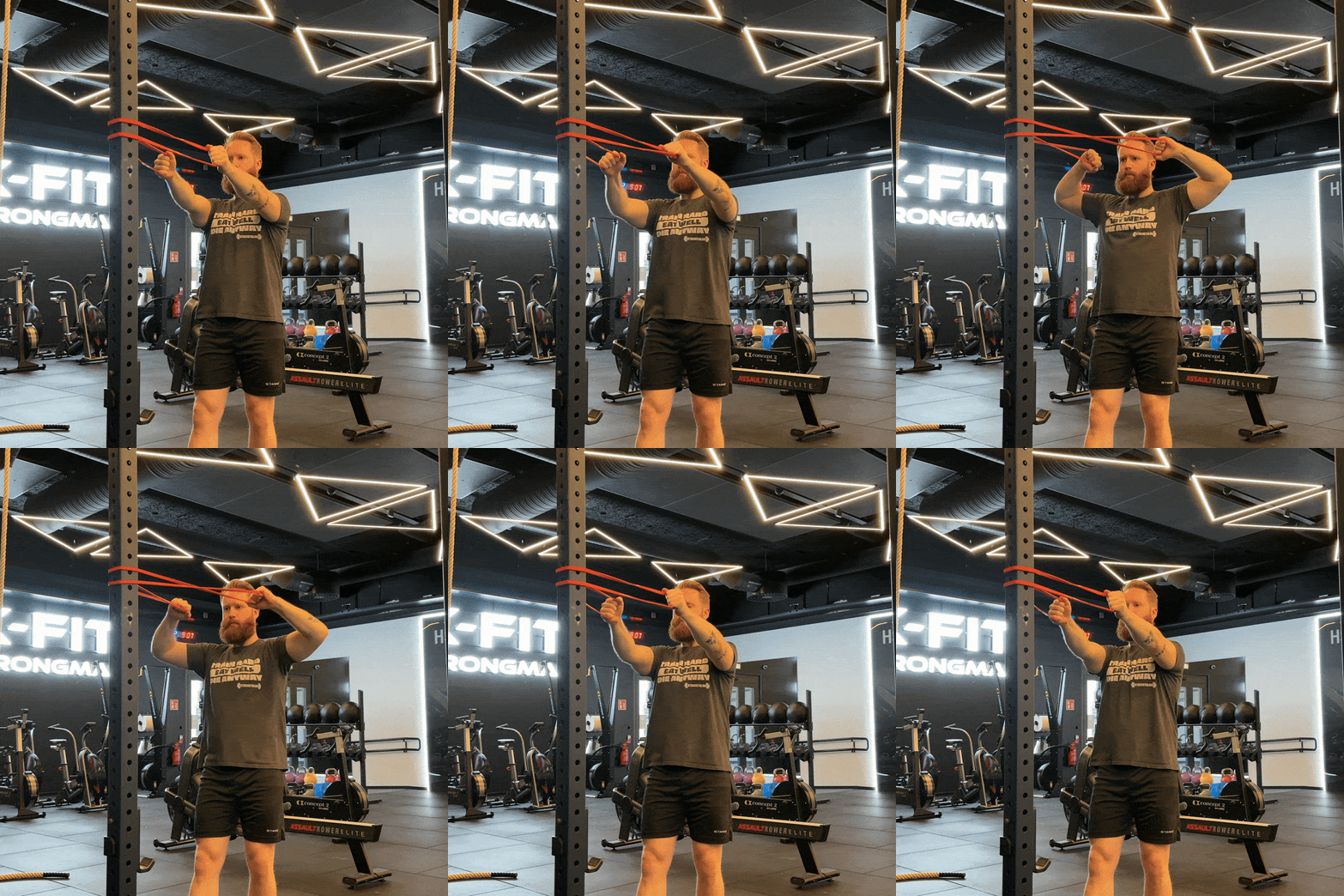
Cable/resistance band face pulls (3x 12-15)
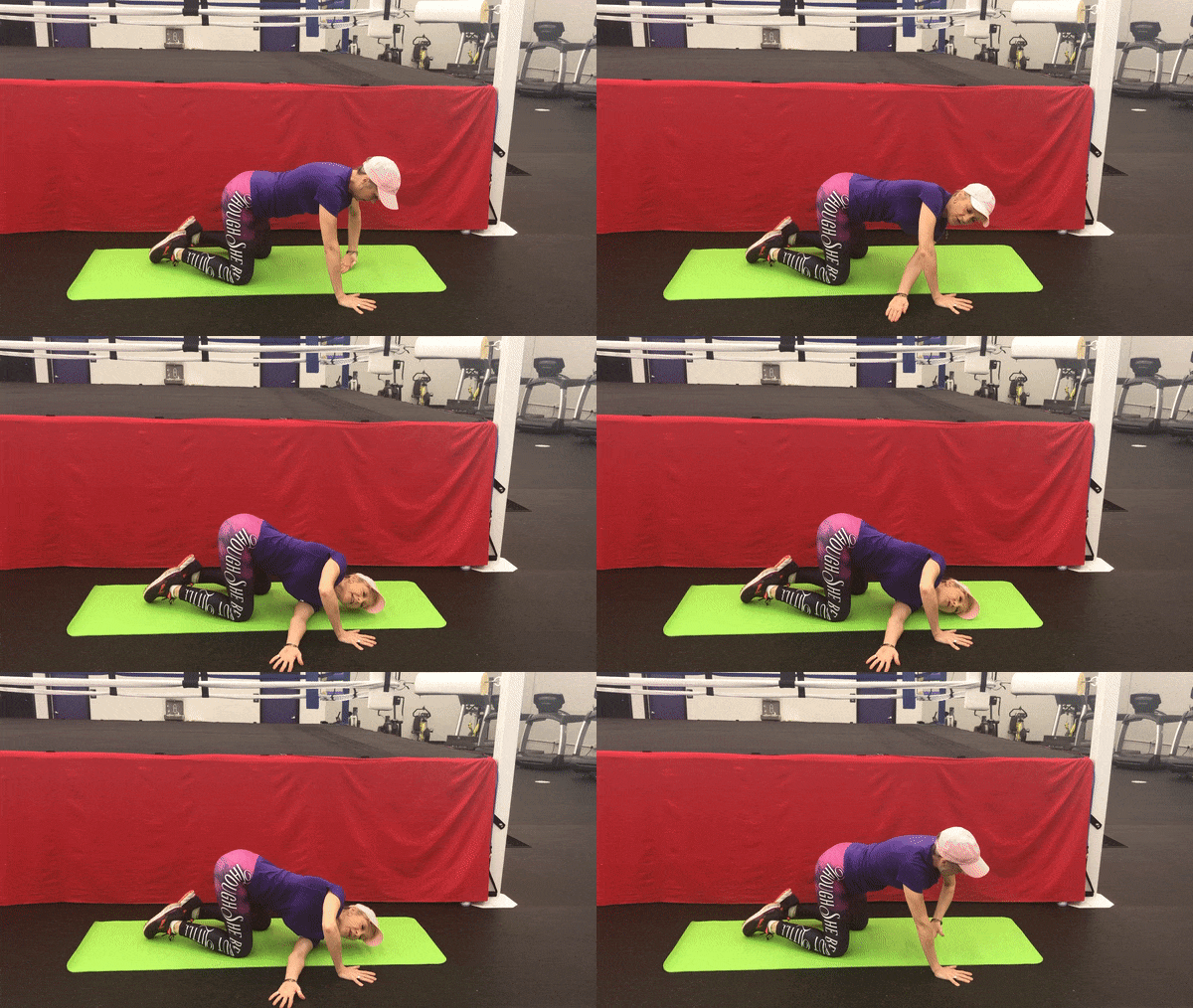
Thread the needle (3x 20s per side)
Test #6 - The Single Leg Calf Raise Test
Ideal Score
At least 25 consecutive reps on each leg, with no greater than a 10% discrepancy between legs.
How to Improve Calf and Achilles Capacity
Chances are you’ll fall into one of two categories here. You’ll either have absolutely smashed this, or got to rep 5 and struggled to do any more. Your performance on this test is also probably strongly linked to your daily step count. If you walk more, you’re going to naturally possess better endurance in your calf muscles and Achilles tendon than someone who doesn’t walk often.
To improve your score, we must be careful to load the tendon sensibly. For the sake of staying consistent and safe, I would suggest adding deficit calf raises into your daily routine for six weeks. However, the sets and reps should increase in blocks every two weeks, as follows.
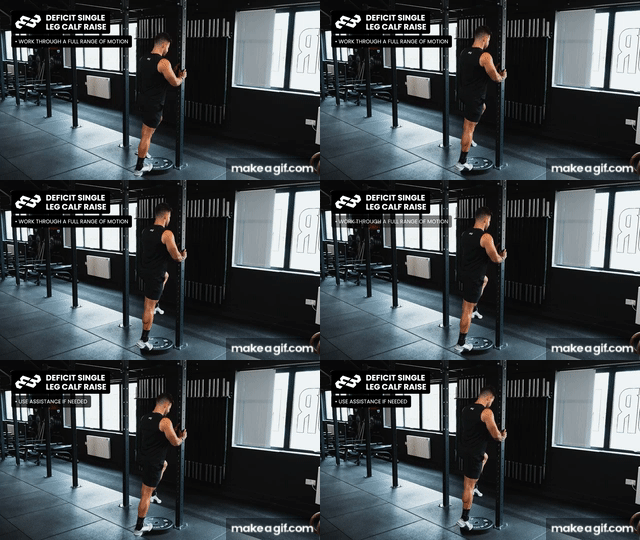
Weeks 1 & 2 should be 3 sets of [your initial test score minus 2 reps]. Take your highest score and use the same number of reps per leg. E.g., if you scored 9 reps on your right leg and 7 on your left, week 1 & 2 should be 3x7 reps daily.
Weeks 3&4 should use your highest test score exactly for 2 sets daily. This would be 3x9 in the example.
Weeks 5&6 should aim for just one set of as many reps as you can manage in one go, daily. You should notice an improvement at this stage.
Test #7 - The Orthostatic Heart Rate Test
Ideal Score
A rise of less than 15 bpm in the 1 minute after standing up.
How to Improve Autonomic Nervous System Function
Unlike the other tests in this battery, autonomic function cannot necessarily be ‘trained’. Instead, there are certain habits which can have a positive effect on your ability to ‘rest and digest’, and I suggest attempting to do one thing daily to improve these habits for a month. For example:
Sleep.
If you are a poor sleeper, try to correct this. Try the 10-3-2-1 rule of avoiding caffeine, heavy meals, alcohol and screens in the hours leading up to bedtime. Make sure that your bedroom is on the cool side, and remember that sleep is paradoxical - in many cases, the more you try to stay awake, the more likely you are to fall asleep. This is why the classic distraction tasks of counting sheep or counting down from 100 can be so effective.
Training volume
If you’re exercising regularly, a poor score on this test might be a sign that you need to either reduce your training volume (deload) or just take some time off. The benefits of reducing your load far outweigh the drawbacks of long-term overtraining and burnout.
‘You’ time
Without being cheesy, make sure that you have time to yourself every day. This doesn’t have to be much, but something as simple as 15 minutes to read before bed or 5 minutes of quiet time to yourself with your morning coffee can be enough. It is part of the reason that journaling can be so effective.
What Do I Do With All This Info?
As I mentioned at the start, be selective with this knowledge. Pick a couple of tests that you wish to improve on most, and implement the suggested tweaks. I’ve deliberately tried to keep my interventions to 4-6 weeks in length so that they can be combined with other changes.
Re-test at the end of your block, and you should notice some positive change. It is worth testing regularly, so try to test at least twice per year if you can. It’ll allow you to catch any negative trends before they become too severe.
Finally, remember, perfection isn’t the goal, but improvement is.
Upgrade Your Subscription
Know Someone Who Would Find This Useful?
If so, please do two things:
Share using the button below.
Hit the ‘restack’ button.
Finally…
I’m going away for two weeks, so you won’t hear from me for a fortnight after this newsletter. However, don’t worry, I’ll be back in late April. In the meantime, you can hit the button below to read all of my works. See you soon!
Excellent information! I can do some of these on my WBV machine. After only a few days, I am able to 20 second one leg stand with the machine running in spiral rotational & soft triplanar mode. I will work on the eyes closed next.